On January 9, Governor Newsom released his proposed state budget. While the Legislative Analyst’s Office (LAO) had identified an $18 billion deficit late last year, Newsom’s budget presents a $2.9 billion deficit in 2026-27.
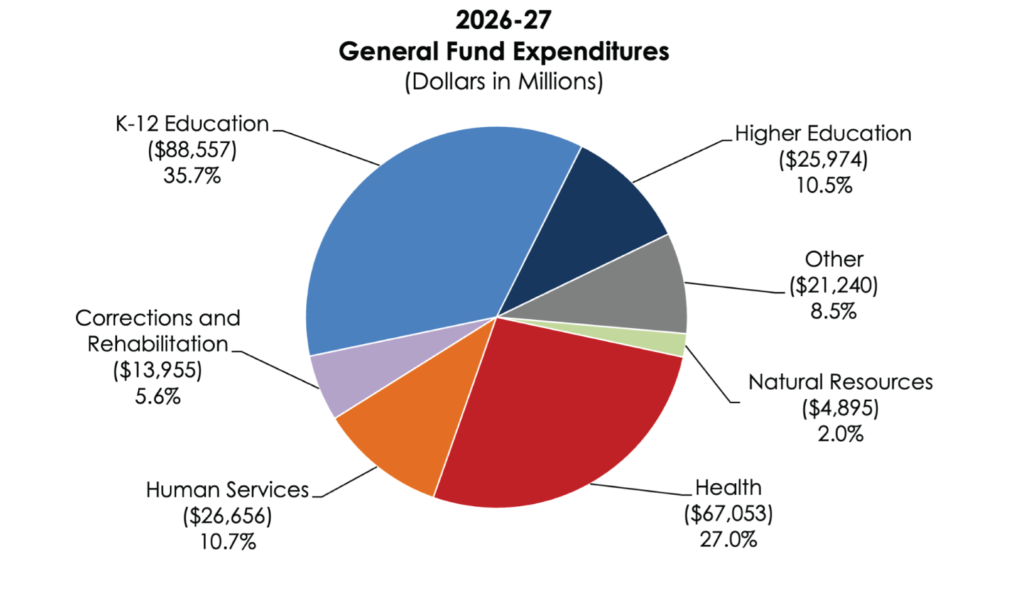
The Governor’s budget contains no new initiatives or large-scale state funding cuts. Importantly, Song-Brown funding for residency training slots remains unchanged from last year’s budget. Some other bright spots in the proposed budget include:
- Rural Health Transformation Program: $233.6 million in federal funds to expand access to care, strengthen the workforce, and enhance health infrastructure in rural communities.
- Behavioral Health: $150 million from the Behavioral Health Services Fund for workforce and prevention programming, with more information provided in the May Revision.
- Reproductive Health Grant Program: $60 million one-time funds for HCAI to provide grants to reproductive health care providers.
- Menopause Services: $3.4 million in 2026-27 and $391,000 Managed Care Fund ongoing, to support health care for perimenopause and menopause.
- Environmental Health:
- Ongoing support from the Greenhouse Gas reduction fund for the Community Air Protection Program;
- $1.6 million ongoing GGRF funds to update the statewide air monitoring plan every five years;
- $95.6 million one-time Air Pollution Control Fund over three years to support efforts to address air pollution, consistent with the Hino Motors Settlement;
- $40.2 million one-time funds to remediate contaminated brownfields and Superfund sites, primarily in disadvantaged communities;
- $2.1 million in special funds to respond to landfill-related public health threats;
- $463,000 special funds to strengthen landfill-related water quality monitoring and response;
- $7.7 million to protect workers from heat illness and wildfire smoke hazards.
The Governor’s proposed budget accounts for cuts to state programs as a result of HR 1, the federal spending bill. These cuts hit Medi-Cal the hardest and hampered California’s ability to provide health coverage to all residents, notably undocumented immigrants. HR1 also changed Medi-Cal and other program administration requirements. As a result, California will be required to:
- Reduce funding for emergency services for adult Medi-Cal enrollees with Unsatisfactory Immigration Status.
- Impose work and community engagement requirements on Medi-Cal enrollees, effective January 1, 2027, resulting in a cost reduction of $102.4 million in state funds for 2026-27.
- ACA redetermination for the certain enrollees will occur once every six months instead of annually, effective January 1, 2027, resulting in a cost reduction of $74.1 million in state funds for 2026-27.
- Reduce retroactive Medi-Cal coverage from three months before an individual’s application date to one month for certain enrollees and two months for all other enrollees, effective January 1, 2027, resulting in a cost reduction of $23 million in state funds in 2026-27.
- Narrow the definition of qualified non-citizens that remain eligible for federally funded Medi-Cal, effective October 1, 2026. This change will exclude certain immigration statuses, which significantly reduces federal funding for this population. State general fund costs to provide full-scope Medi-Cal to this population in 2026-27 would be $786 million. The budget proposes to instead move these individuals to restricted scope Medi-Cal.
What’s Next? CAFP advocates and the legislative Budget Committees will begin their analysis of the proposal and start hearings later this month and continue in-depth hearings through May. CAFP will develop its budget priorities, ensuring we are the leading voice for access to quality primary care.