Governor Gavin Newsom presented his revised budget proposal on May 14, 2026 during a livestreamed presentation from Sacramento. The May Revision, commonly referred to as the “May Revise,” updates the Governor’s January budget proposal using the latest revenue projections and economic data and serves as the framework for final budget negotiations with the Legislature.
In his presentation of the revised budget, the Governor repeatedly highlighted California’s economic strengths, arguing that California continues to outperform much of the nation economically and showcased a series of state investments and program outcomes intended to demonstrate government effectiveness.
At the same time, the Governor warned that federal policies are creating significant financial challenges for California. He cited tariffs, proposed federal program and grant reductions, rising international instability, including the war in Iran, and increased state costs associated with H.R. 1 as threats to California’s economic progress and fiscal outlook.
While revenue projections have increased by $16.5 billion over what was projected in the Governor’s January budget, the proposal includes new revenue streams and significant spending reductions, particularly in state operations, corrections, and healthcare. According to the Governor, these changes will eliminate California’s budget deficit through July 2028.
Budget Summary
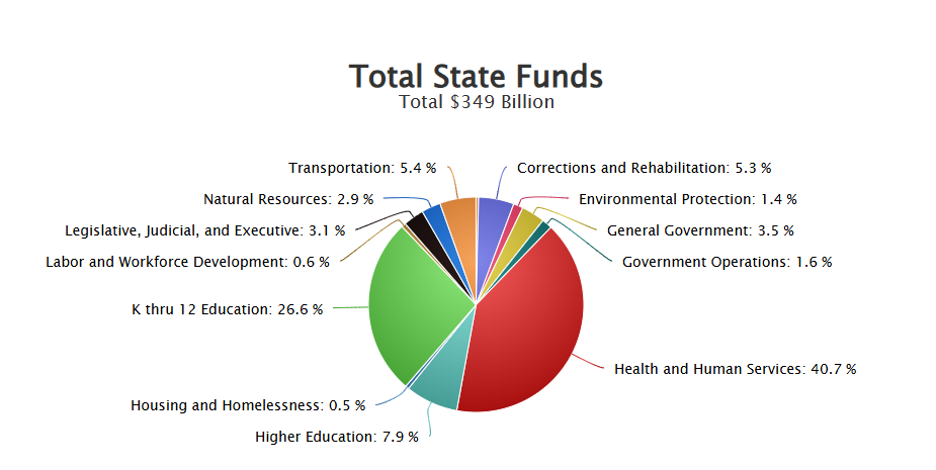
The 2026-27 May Revision proposes $349.4 billion in total state fund expenditures, consisting of approximately $246.6 billion from the General Fund, $95.6 billion from special funds, and $7.3 billion from bond funds.
New Sources of Revenue and MCO Tax
- The May Revision proposes several new sources of revenue, including a permanent business tax credit limitation, a digital software sales tax, and a new managed care organization (MCO) tax. These revenue sources are projected to generate $1.9 billion in 2026-27 and $4.9 billion in 2027-2028 in additional revenue. The MCO tax proposal extends, but does not increase, the current tax, which is set to expire at the end of the year. The current MCO tax, established by supports Medi-Cal and helps sustain targeted rate increases for primary care, maternal health, and non-specialty mental health services.
Proposed Changes to Medi-Cal
The May revision includes the following General Fund investments and reductions to Medi-Cal:
- Increase of $262 million ($74 million General Fund) in 2026-27, $33 million ($16.7 million General Fund) in 2027-28 and 2028-29 to support county workload for the implementation of Medi-Cal eligibility changes pursuant to H.R. 1.
- Increase of $669 million General Fund in 2026-27 (increasing to $718 million) due to a federal policy reducing the match rate from 90% to 50% for emergency services provided to ACA expansion adults with unsatisfactory immigration status, effective October 1, 2026.
- $68 million General Fund reduction in 2026-27, growing to $552 million by 2029-30, from adding utilization management requirements for applied behavioral analysis and transportation services and eliminating the Medi-Cal managed care quality withhold incentive component.
- $278.3 million General Fund reduction in 2026-27 and $495.6 million ongoing from reinstating Medi-Cal asset limits for seniors and disabled adults at $2,000 for individuals and $3,000 for couples beginning January 1, 2027.
- $427.3 million General Fund reduction in 2027-28, decreasing to $314.3 million annually by 2029-30, from increasing monthly Medi-Cal premiums for adults ages 19–59 with unsatisfactory immigration status from $30 to $50 beginning July 1, 2027.
- $583.8 million General Fund reduction in 2026-27 and $1.5 billion ongoing from transitioning Medi-Cal members with unsatisfactory immigration status from managed care to fee-for-service beginning January 1, 2027, in response to new federal requirements limiting coverage in risk-based managed care systems.
- These General Fund reductions do not include additional reductions that are expected to result from Medi-Cal disenrollments driven by the implementation of work and community engagement requirements, more frequent eligibility redeterminations, shortened retroactive coverage timeframes, and new immigrant eligibility restrictions under H.R. 1.
Other Noteworthy Health Investments
- Covered California Premium Subsidies - $110 million increase from the Health Care Affordability Reserve Fund ($300 million ongoing) for Covered California to expand the state premium subsidy program to enrollees up to 200 percent of the Federal Poverty Level.
- AIDS Drug Assistance Program - $60 million in one-time funding for the AIDS Drug Assistance Program Rebate Fund, including $50 million to support services for those living with and at risk of HIV, especially services impacted by loss of federal funds, and $10 million for LGBTQ+ community centers experiencing a loss of federal funds.
- Statewide Menopause Campaign - $3 million one-time General Funding for a statewide public awareness campaign to support greater understanding of perimenopause and menopause.
- Hospitals in Financial Distress - Up to $50 million from the state General Fund in 2026-27 that can be used by the Department of Health Care Access and Information to help hospitals facing serious short-term financial problems.
- Sickle Cell Centers of Excellence - $30 million General Fund, over five years, to support Sickle Cell Centers of Excellence to provide treatment and health care for individuals with sickle cell disease.
- Food and Nutrition - $30 million one-time General Fund for food banks in 2026-27
Budget Negotiations Ahead and CAFP’s Continued Advocacy for Patients and Physicians
The Governor’s revised budget proposal sets the foundation for negotiations among the Governor, Assembly, and Senate as they work toward a final spending plan ahead of the June 15 constitutional deadline for passing the State budget. Because California’s budget is ultimately a three-party agreement between the administration and each house of the Legislature, significant changes to the proposal are possible in the coming weeks.
Healthcare funding is expected to remain a major focus throughout the remainder of the session, particularly as lawmakers continue to debate proposals related to Medi-Cal reductions. Several bills currently moving through the Legislature, and supported by CAFP, seek to address or mitigate proposed cuts, setting the stage for continued negotiations over access to care and the future of California’s health care safety net. CAFP will continue to advocate for policies and a budget that supports physicians and expands, not restricts, access to healthcare for all Californians.